THE ULTIMATE WINTER TRAVEL GUIDE TO SALZBURG, AUSTRIA
I fell for Salzburg on a bright December day, during a day trip from Munich. The train ride alone was worth it — two hours through the Bavarian countryside, past little villages dusted in snow, frozen fields so quiet it felt like the whole world had paused, and the Alps sitting on the horizon the entire time, huge and watching. By the time I stepped off the train, the city had already half-won me over.
Salzburg has an indefinable charm, as if time simply forgot to move on since Mozart was born here more than 250 years ago. And yet this is a city that has known destruction: more than 40% of it was reduced to rubble during World War II bombings. What rose from the ashes was rebuilt so faithfully that in 1996, UNESCO named it a World Heritage Site. To wander its cobbled streets is to lose track of which century you’re in. Baroque façades line the elegant squares, sunlight catches the sculpted fountains, and small tributes to Mozart show up here and there — a plaque, a statue, a street named after him. Follow the Salzach River and you’ll stumble upon some of the most breathtaking views the city has to offer, crowned by the Hohensalzburg Fortress — rising high above the rooftops and church steeples.
Winter gives Salzburg a glow all its own. Snow gathers on the rooftops, softening the pastel façades and church towers into something almost dreamlike. The streets pull you in one direction after another — a cozy café here, a Christmas market lit up there, a restaurant with the promise of something warm just as the cold starts to get to you.
If you’re looking for the best things to see and do in Salzburg this winter, this guide will help you make the most of your stay in one of Austria’s most elegant cities.
SALZBURG OVERVIEW
WHERE | Salzburg, Austria
GETTING THERE | Train, bus, international & domestic airport
GETTING AROUND | Walk, Bus, Tramway, Train, Bike & Car rental
TOP THINGS TO SEE | Festung Hohensalzburg, Mirabell Palace & Gardens, Mozart’s places, Dom zu Salzburg, Kapuzinerberg, Getreidegasse, Untersberg
WHAT TO EAT | Schnitzel, Kasnocken, Tafelspitz, Salzburger Nockerl, Apfelstrudel, Mozartkugel, Stiegl Bier
BEST TIME TO VISIT | April to October & December for Christmas Market
CURRENCY | Euros €
GETTING TO SALZBURG
By Plane : Salzburg Airport offers convenient connections to many major European Cities. It is located just 20 minutes from the city centre and is easily accessible by bus, with departures every 15 minutes between 5h & 23h. A taxi ride to the city centre costs around €20.
By Bus : the domestic and international bus station is located near Salzburg Hauptbahnhof (the main train station).
By Train : Salzburg has excellent rail connections with the rest of Austria. Trains leave frequently for Vienna (reached in less than 3h). You can as well use your Deutschlandticket to reach Salzburg from Germany (Munich in 2h30). Direct trains also link Salzburg with Berlin, Budapest, Prague, and Venice.
GETTING AROUND SALZBURG
By Bicycle : Salzburg is one of Austria’s most bike-friendly cities, with an extensive network of scenic cycling paths stretching in all directions — including beautiful routes along the Salzach River. While winter can make cycling a bit challenging, on a sunny winter day it’s a fantastic and eco-friendly way to explore the city!
By Bus and Tram : The city is well connected by an efficient network of buses and trams
By Car : the city centre is largely car-free but several underground car parks are available near the old town’s entrances.
WHAT TO SEE & DO IN SALZBURG IN WINTER
Stroll through Alstadt (Old Town)
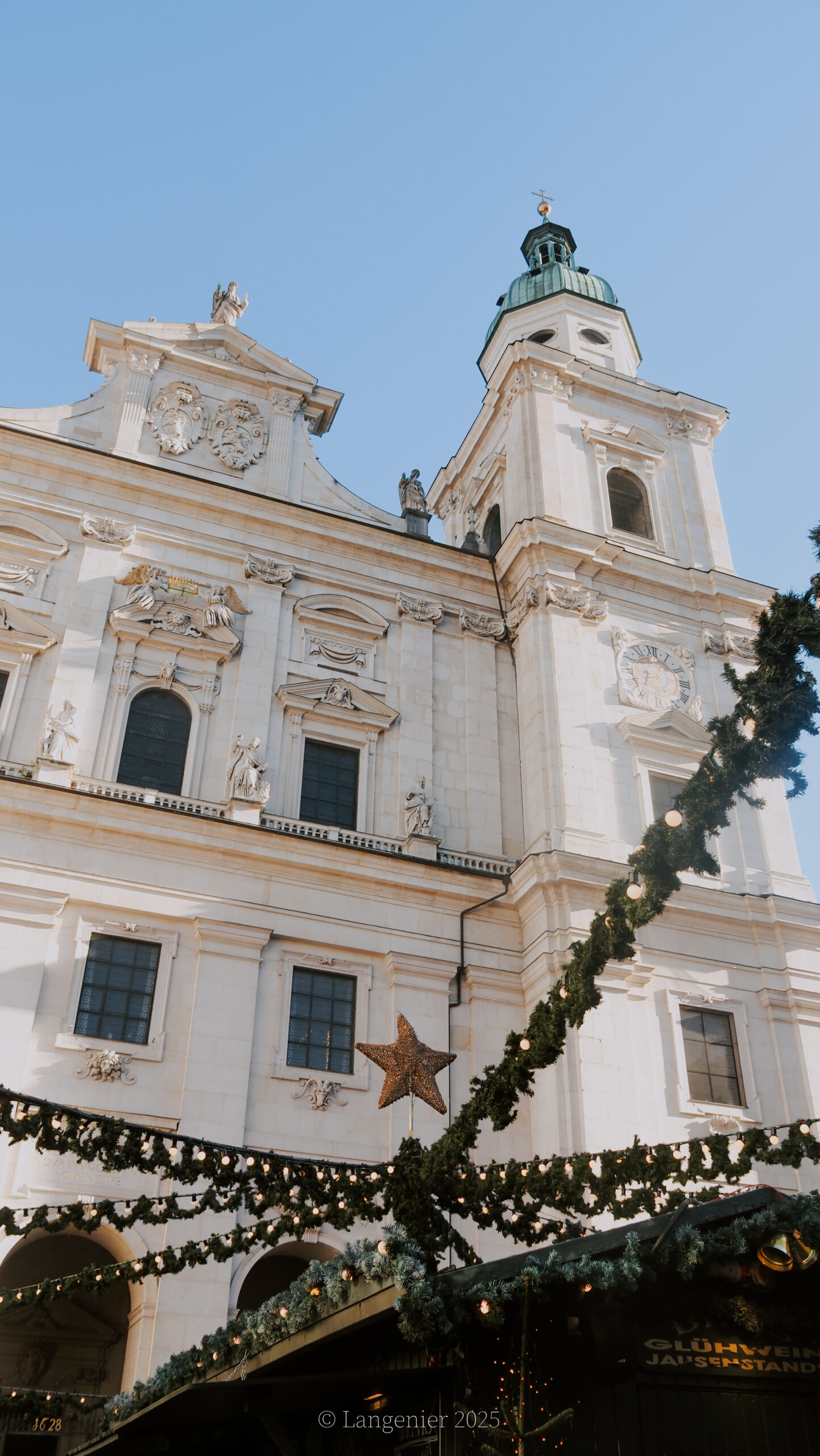
Start at Domplatz, a large rectangular square dominated by the DomCathedral, built in the 17th century. Its interior is impressive, with vast spaces, richly decorated marble, stucco, and paintings, and five organs, where Baroque blends with Italian Renaissance influences.
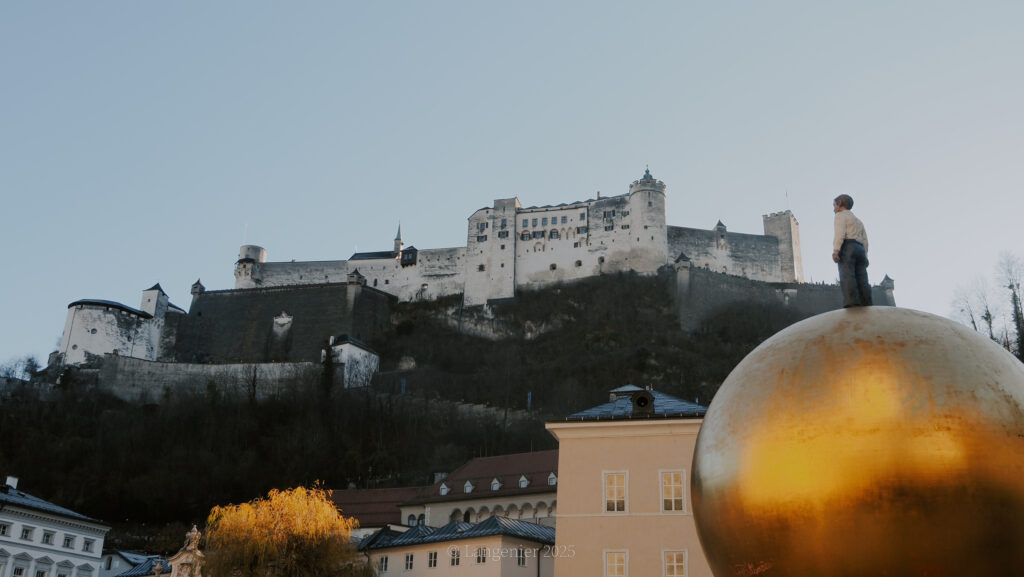
Then head to Kapitelplatz, where you will be intrigued by the Sphaer, a contemporary sculpture nine meters high depicting a man standing on a golden sphere. Don’t miss Stiftskirche St. Peter, a Romanesque basilica with Baroque decor; its vaulted nave is decorated with frescoes depicting the life of Saint Peter. About thirty Benedictine monks still live in the adjoining monastery.
Continue to Universitätsplatz and enter the Kollegienkirche, an imposing Baroque monument that is immaculately white and luminous all year round. I consider it to be the most beautiful church in Salzburg. It was originally intended for the university founded in 1623 by the Benedictines.
Then lose yourself in the charming little passageways and courtyards,often decorated for the holiday season and housing charming shops and restaurants. They lead to Getreidegasse, one of the main shopping streets in old Salzburg. Lined with colorful 4-5 level houses, it retains the lively atmosphere of the Middle Ages and its famous wrought-iron signs. Here you will find traditional clothing, international brands, chocolates, and Mozart’s birthplace.
End your walk at the Alter Marktplatz, one of the most picturesque place in the old town.
Discover Mozart’s legacy in Salzburg
The city is inextricably linked to the genius of Wolfgang Amadeus Mozart, born here in 1756. His birthplace, at 9 Getreidegasse (Mozarts Geburtshaus), is now a museum housing his violins, his clavichord (the precursor to the piano), scores, and letters.
The Mozart Wohnhaus (Residence), on the right bank, where he lived and composed part of his work, displays antique instruments and documents about his family and his era. The tour, accompanied by musical excerpts and a map of Europe at the time, traces his travels across Europe and his career. The house also contains the Mozart Sound and Cinema Collection, an interactive room with a variety of audio and video documents.
Despite his early success and touring Europe from the age of 6, Mozart left Salzburg at the age of 26, penniless, following the death of his mother and eternal conflicts with the Archbishop of Salzburg who employed him. It was in Vienna that he composed his greatest works, The Marriage of Figaro (1786) and Don Giovanni (1787), which received mixed reviews at the time. Despite the success of The Magic Flute in 1791, he ended his life in solitude and poverty and died in almost total obscurity.
It was not until 1917, thanks to Richard Strauss, that his genius was fully recognized. The Salzburg Festival, inaugurated in 1920, has since celebrated his works every summer with concerts, operas, and ballets performed by renowned artists and orchestras. All year round, the Salzburg Opera and various venues offer opera performances and chamber concerts, for the pleasure of both eyes & ears.
Explore Salzburg Christmas Market
Running from late November to January 1st, Salzburg’s Christmas market is one of the oldest and most beautiful in Europe. Its origins date back to the late 15th century, when the “Nikolaimarkt” (Saint Nicholas’ Market) offered seasonal treats, gifts, and handmade goods around Cathedral Square.
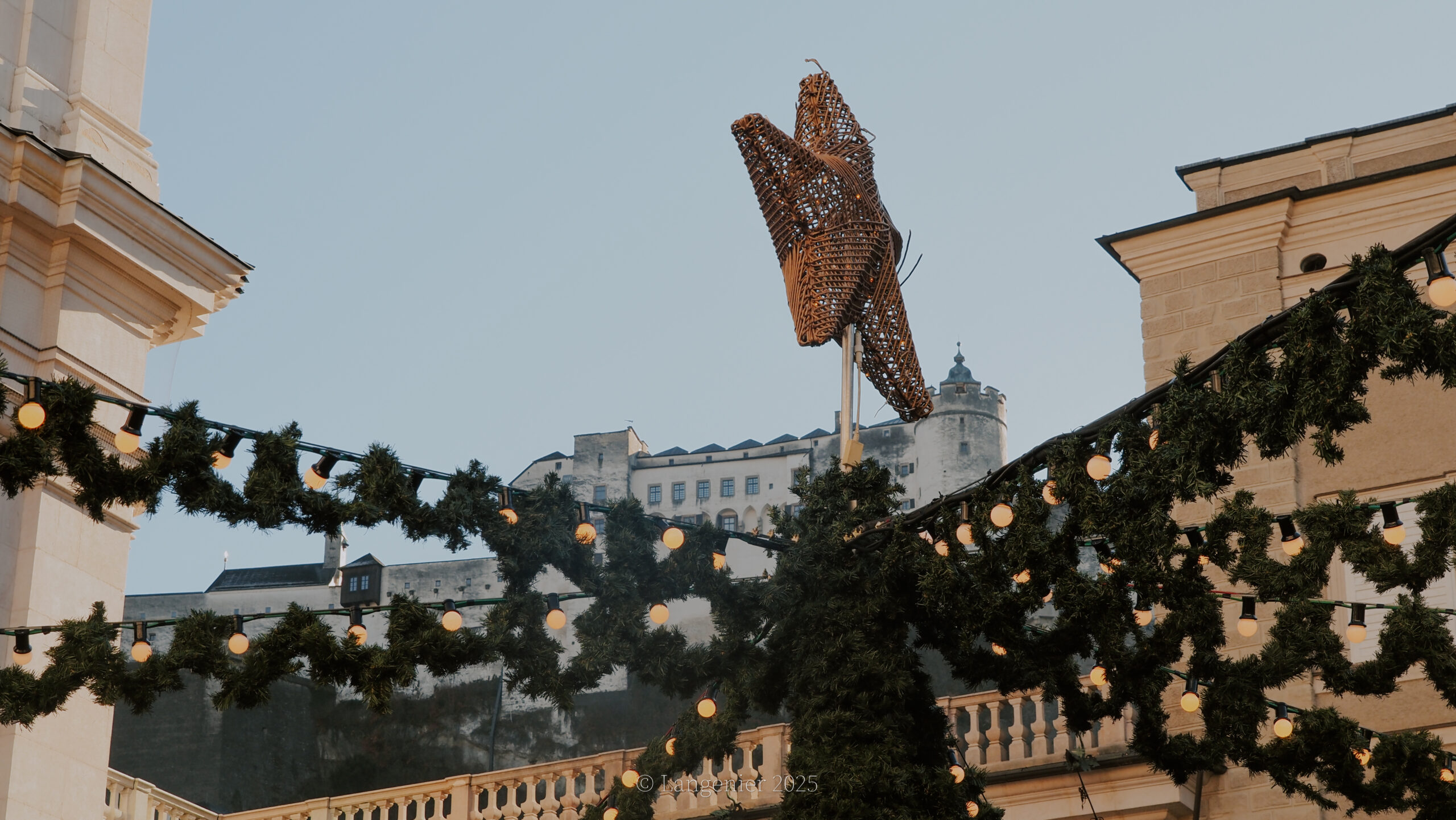
Today’s Salzburg Christkindlmarkt, established in 1974, on Residenzplatz, attracts thousands of visitors each year. You can shop for traditional decorations, local crafts, and festive treats, and sample Austrian specialties, mulled wine, and hot punch (a warm spiced fruit juice, served with or without alcohol).
The market also offers a variety of seasonal activities (2025 updated).
- Sing-Along Choir: Open to the public every Tuesday from 18h to 20h
- Traditional Wind Music: Performed above the square every Wednesday at 18h, and Thursday & Saturday at 18h30.
- Visit from the Salzburg “Christ Child” with angels every Sunday at 16h.
- Children’s Reading with the Christ Child every Wednesday at 16h.
The market is open daily from around 9/10h to 20h30/21h.
Visit the Castles of Salzburg
On the left bank, Hohensalzburg Fortress, perched 120 meters above the Salzach River, is an 11th-century fortress that was gradually transformed over the centuries into a comfortable residence and defensive stronghold for the archbishops. Opened to the public at the end of the 19th century, it remains one of the largest and best-preserved fortresses in Europe. You can easily spend half a day here, especially to enjoy the spectacular views over the region, which are particularly stunning at sunset from the Kuenburg bastion terrace and the castle museum’s observation tower. The fortress is a 15-minute walk from the center or can be reached more quickly via the glass Festungsbahn funicular.
On the right bank, the Mirabell Palace gardens (free entry) filled with flowers, statues, and sculpted fountains, are a true feast for the eyes. From a terrace platform forming a belvedere, the view over the gardens, the rose garden, the old bastions, and the Hohensalzburg Fortress is spectacular, so much so that the location was used for filming the classic 1960s movie The Sound of Music. The splendid Schloss Mirabell was built in 1606 by Prince-Archbishop Wolf Dietrich and remodeled in Baroque style the following century. The restored former orangery buildings surround a charming courtyard and house the Baroque Museum in their south wing. The famous Marble Hall (Marmorsaal), with its rich gilded and polychrome stucco decorations, provides a sublime backdrop for evening chamber concerts and wedding venues.
Hike the Kapuzinerberg (Capucin Hill)
To reach Kapuzinerberg, you can take a small, steep staircase called Imberstiege, which starts at Steingasse, under a covered passageway, or Stefan-Zweig-Weg from Linzergasse.
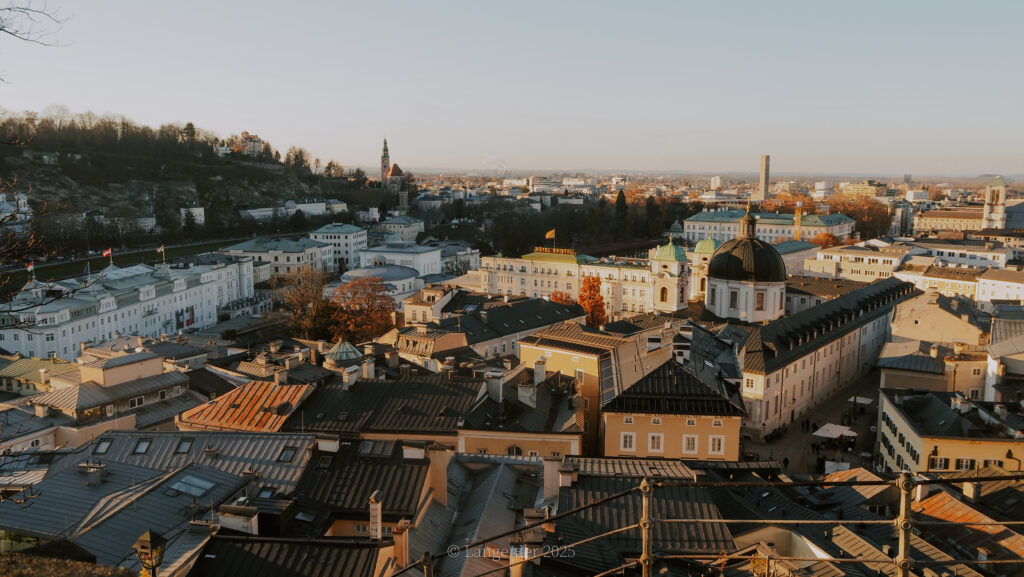
The peaceful, wooded Kapuzinerberg rises to 640 m and is crisscrossed by trails offering magnificent views of the Altstadt and the fortress. Along the way, you can discover the six Baroque chapels of the Way of the Cross that mark the climb.
From the bastion on the southern edge of the hill, the view of the left bank district is spectacular. In the early morning, the soft morning light illuminates the copper roofs and bell towers and highlights the structure of the old quarters. The warmer evening light emphasizes the castle and the mountain behind it where the sun sets, and the old town appears nestled between the Salzach River and the steep hill on which the citadel stands.
Take a trip to Untersberg
The Untersberg, which rises to an altitude of 1,853 meters, dominates Salzburg and extends to the German border. It offers spectacular views of the city, the valley, and the Alpine massifs of Tyrol, Salzburg, and Bavaria. The mountain attracts skiers in winter and hikers, climbers, and paragliders in summer.
From the top station of the cable car, short, easy trails lead to nearby viewpoints such as the Geiereck (1,805 m) and the Salzburg Hochthron (1,853 m), while other routes delve deeper into the Alps. Temperatures are often cooler here and the trails can be unstable, so bring warm clothing and sturdy shoes, regardless of the season.
The cable car runs to the summit every 30 minutes (€34 or free with the Salzburg Card). To get to the departure station, take bus 25 from Salzburg main station or Mirabellplatz to St. Leonhard.
If you’re planning a trip to Austria and heading to Vienna as well, don’t miss my post on three of Vienna’s most beautiful palaces — all free to enter and seriously underrated!
2 Comments