HIKING THE CALANQUES OF CASSIS : WHAT YOU NEED TO KNOW
Belonging somewhere can blind you to it. I spent my teenage years in Provence, absorbed in its everyday rhythm, sure I already knew the place — until I left in my twenties for another region, and only then did I realise that I didn’t know that much about the place that made me grow. You know how it goes. You live somewhere for years and never really explore it. There’s always a “next time,” a “later,” a “next year.” And somehow that year never arrives — because life fills itself with other things, nearer things, more urgent things, until the place right outside your door becomes the one you know the least. I realized this two years ago, while leaving Provence. And I told myself I wouldn’t be one of those people who never actually see where they’re from. So that summer of 2024, I stayed a little longer and explored the area around Provence instead of rushing off.
That’s how I found the Calanques of Cassis.
Not long ago, the Calanques — those rocky inlets stretching from Marseille to La Ciotat — belonged mostly to locals, and to the rare traveller who knew where to look. Today, they’re among the most photographed landscapes in the south of France, drawing people chasing that impossibly blue idea of the Mediterranean. Sometimes the beauty is so sharp it feels like you’ve been dropped somewhere else entirely — Greece, maybe — even though you’re barely twenty minutes from Marseille.
Not all calanques are the same. To the west, L’Estaque and the Côte Bleue stay quiet, mostly local, mostly overlooked. East of Marseille, the calanques of Luminy — a short bus ride from downtown — give you your first real taste of the landscape, still a little raw. Further along, near La Ciotat, the water turns a blue so deep it barely looks real — maybe the most beautiful shade in the whole region.
And then there’s Cassis. The calanques that invite you to slow down. To walk, to pause & to slip into the water. In this post, you’ll find everything you need to plan the perfect day in the Calanques de Cassis — from getting there to exploring the park at your own pace, and making the most of this beautiful part of France.
PROVENCE OVERVIEW
WHERE | Provence, France
GETTING THERE | Trains from Paris, Milan, ect & International & Domestic airport
GETTING AROUND | Walk, Bus, Tramway, Metro, Train, Car Rental
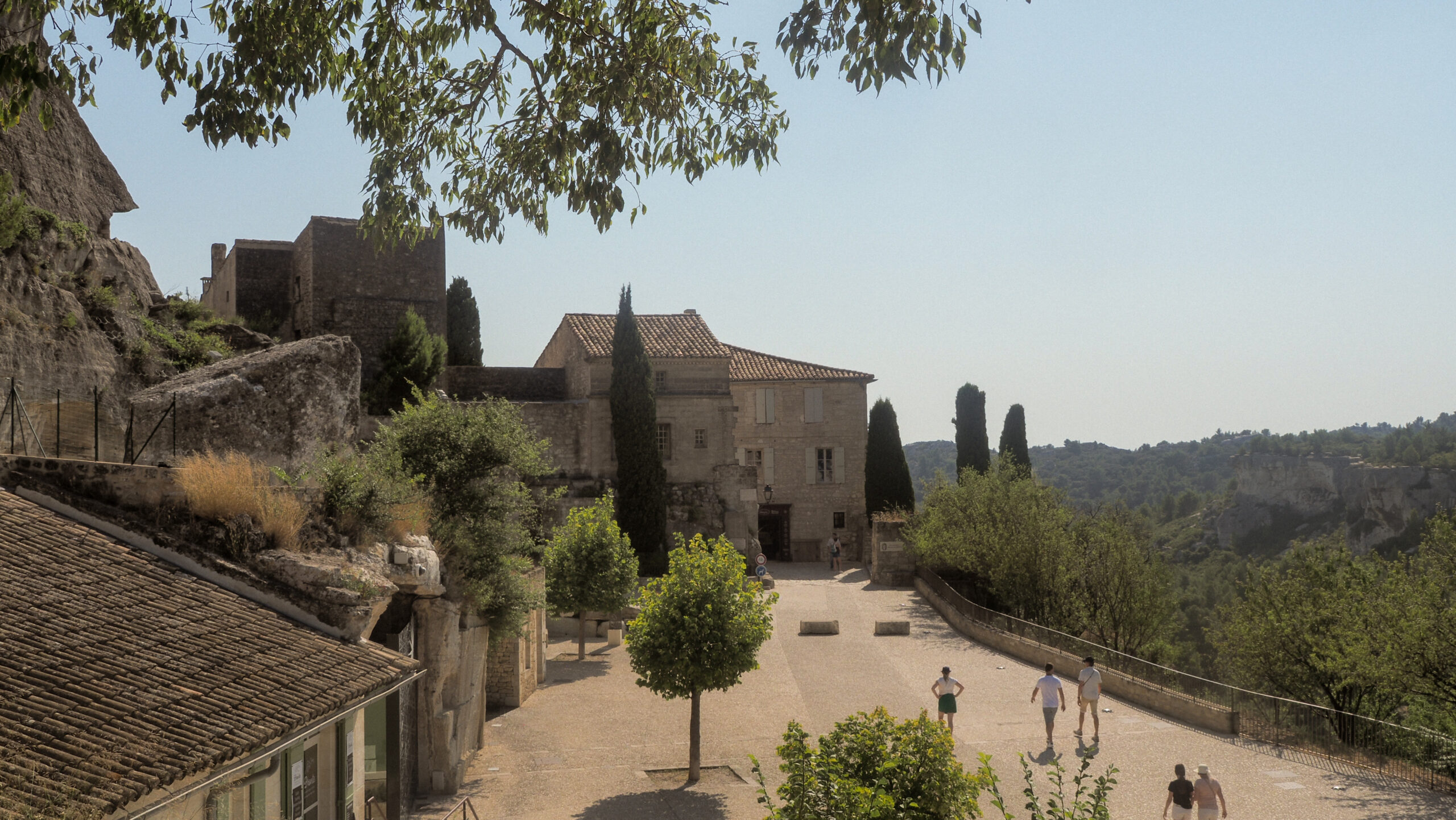
WHAT TO SEE | Vieux Port of Marseille, Notre-Dame de la Garde, Parc National des Calanques, Aix-en-Provence, Cassis, Arles, les Baux-de-Provence, Iles du Frioul
WHAT TO EAT | Bouillabaisse (fish stew), Panisse (chickpea flour fritters), aioli sauce, passaladière (onion tart), tapenade (olive spread), sardines & grilled fish, navettes (biscuits), provençal cheese
BEST TIME TO VISIT | With its Mediterranean climate, Provence is great year-round, though I love June (for lavender flowers) and September.
CURRENCY | Euros €
1. PRACTICAL INFORMATION
First and foremost, if you’re planning to visit the Calanques de Cassis, it’s worth checking out some practical information.
- Allow around 3 hours for the round trip to reach the 3 creeks at your own pace.
- It’s advisable to bring 2 liters of water. There are no shops in the protected park, except at the entrance, where the store only opens at 2pm in high season.
- Remember to bring sunscreen, sunglasses and a hat. Although the path is largely shaded by the many pine trees that surround it, the sun can be particularly hot.
- Bring good walking shoes or sneakers. The terrain is very uneven, and the stones, polished by hundreds of walkers every day, can become slippery, very slippery.
- Arrive early in the morning to enjoy the calanques before the lunch/afternoon rush.
Difficulty : Calanque de Port-Pin and Port-Miou are suitable for families. Calanque d’En-Vaux is accessible if you’re in good shape, but don’t underestimate the route and think about the return !
2. HOW TO GET TO CALANQUES DE CASSIS
- By train: Take a regional train from Marseille or Toulon, usually available every hour. The journey takes 25/30 minutes to the outlying Cassis station. To get in the city center, you can take the M1 bus, rent Lime self-service bicycles, or walk through the wineries of Cassis. Once in the city-center you will see signs to get to the Calanques, on the west of the city.
- By bus: From Marseille Castellane, line 78 leaves every hour. The scenic route through La Gineste takes you to downtown Cassis in 25 minutes. Once in the city center, you will see signs leading you to the parc, on the west of the city.
- By car: From Marseille, allow 30 minutes (1h from Toulon). If possible, take the Route des Crêtes from La Ciotat, which is part of the Parc National des Calanques and offers spectacular views from its many lookouts along the coast. In Cassis, parking is charged at a maximum of 10€/day.
3. THE PERFECT ITINERARY TO DISCOVER THE CALANQUES OF CASSIS
Three distinct calanques shape the Calanques de Cassis along the Mediterranean coast.
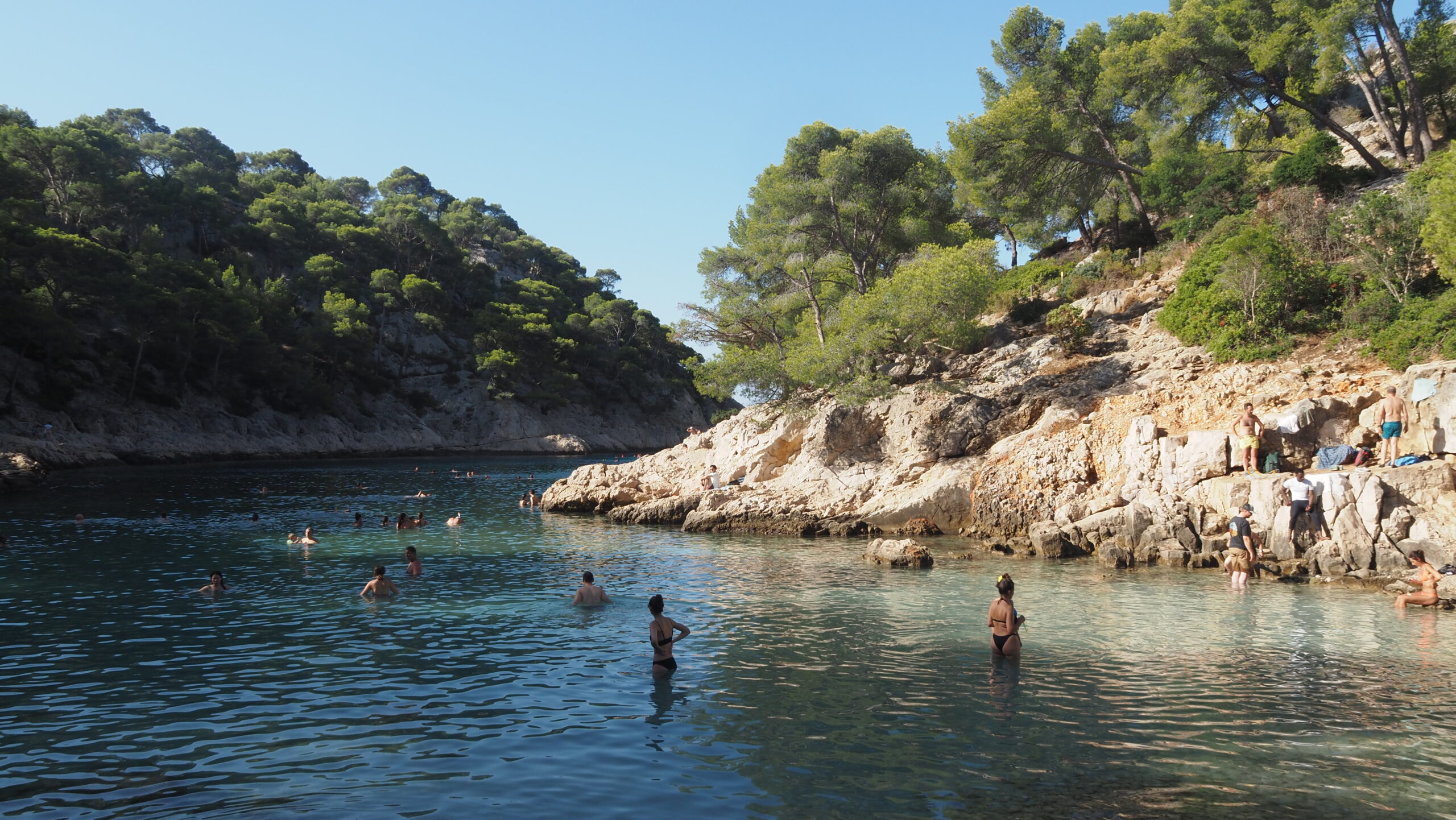
The first, Calanque de Port-Miou, lies just ten minutes from the park entrance, making it the most accessible of the three. Once a former stone quarry, it now serves as a nautical hub, home to more than 500 boats. making it the most accessible. Beyond its marina, Port-Miou offers a beautiful view of Cap Canaille de Cassis, whose ochre cliffs plunge into the sea.
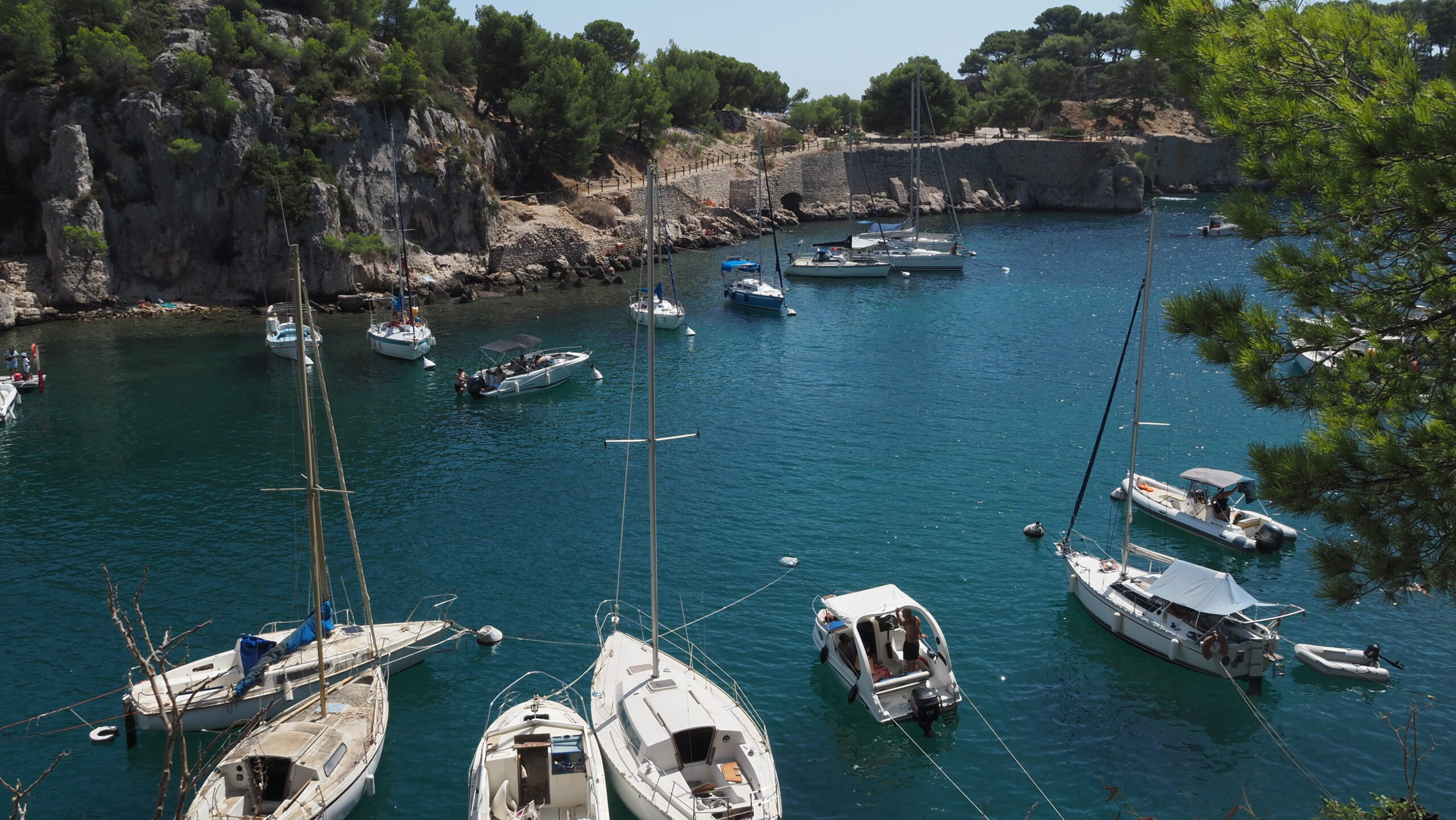
Next comes Calanque de Port-Pin, reached after a 20-minute walk along a more demanding trail punctuated by short climbs. The path ends with a series of steps descending to the beach, where you can admire the clear blue-green water of the Mediterranean. Easily accessible and popular with families, Port-Pin is a favorite picnic spot — a popularity that means the beach fills quickly, so it’s hard to find a quiet spot.
That is precisely why the third, Calanque d’En-Vau, remains the most physically demanding — and the most rewarding. Less crowded and more dramatic, it is reached after leaving Port-Pin, where hikers can choose between a scenic route or a shorter, more demanding, direct path. I opted for the latter on the way in, hoping to avoid the crowds as much as possible.
The trail consists of a succession of steep ascents to the top of a cliff, followed by a long descent through a narrow passage. Although there are iron handholds to assist hikers, the terrain requires care : take your time and choose your footing carefully, as the slip could be painful. At the end of the descent, the path becomes fairly flat, framed by imposing white limestone cliffs that remind of a canyon.
As you round the final bend, Calanque d’En-Vau suddenly reveals itself — a palette of blues ranging from bright turquoise to deep navy, shifting with depth, algae and light. The water is inviting, and, surprisingly, comfortably warm — something rare in the calanques, where cooler water temperatures are often caused by underwater springs, local geography, and the mistral wind.
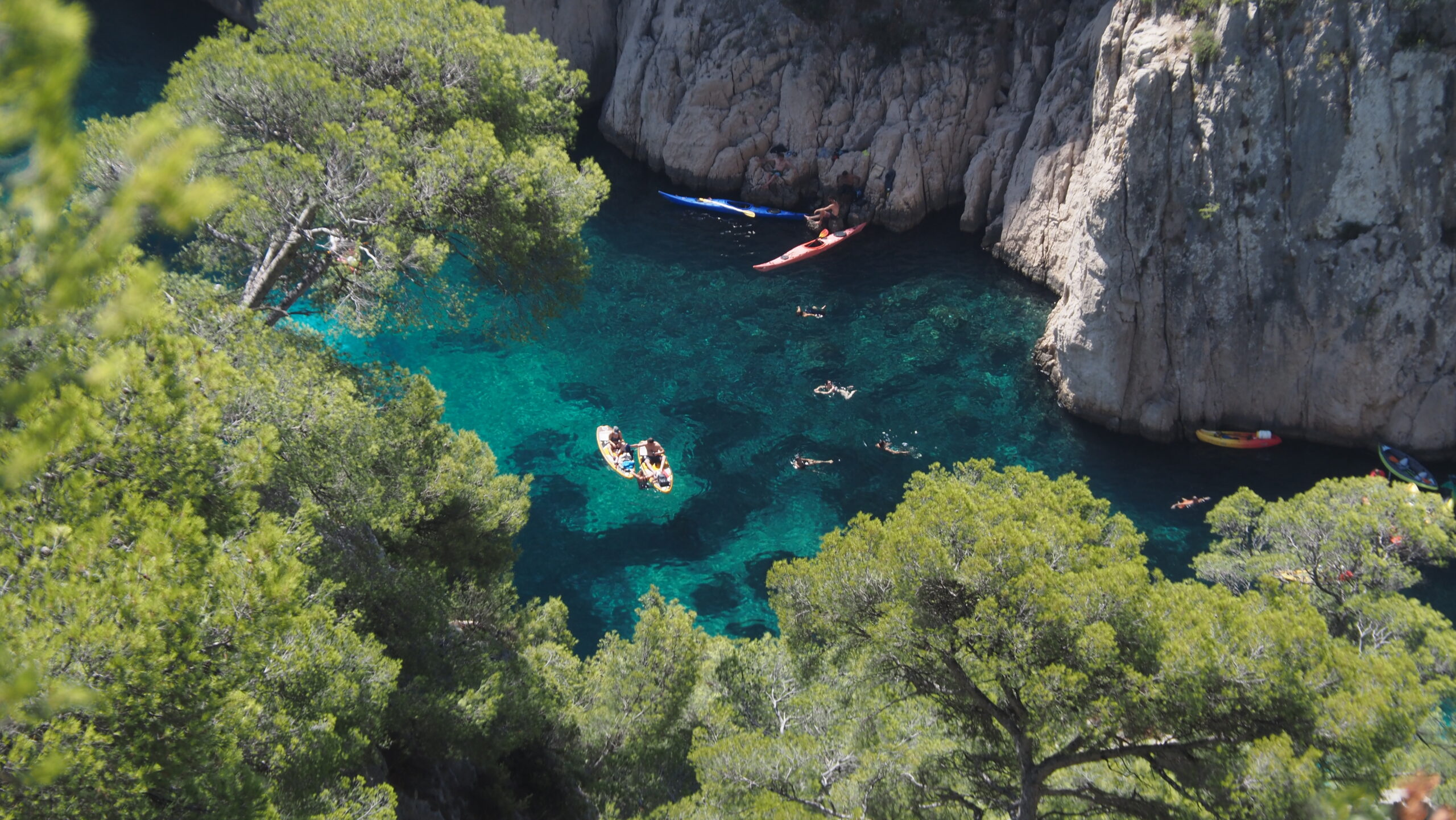
I arrived around 10h (august), when the beach was already beginning to fill with colorful towels, sun umbrellas, and canoes moored against the cliffs For some peace, it’s easy enough to find a path along the edges of the calanques to reach rocky perches above the water.
For the return journey, it is possible to retrace the same route, but I highly recommend taking the panoramic trail after the climb back to the cliff top. Though longer, the views justify the effort. Rather than passing through pine forest, the path follows the coastline with breathtaking views over the blue waters of En-Vau and, further on, the dramatic silhouette of Cap Canaille as you make your way back toward Port-Miou.
☆
If you’re looking to explore the Provence region, I’ve put together a detailed guide to seven of the best day trips from Marseille — a curated selection to help you discover the region’s highlights and hidden treasures.
![WHERE TO STAY AROUND PARIS [BEST AREAS]](https://langenier.com/wp-content/uploads/2026/02/Airelles-Chateau-de-Versailles-Le-Grand-Controle-where-to-stay-around-Paris-what-to-see-around-Paris-best-day-trips-from-Paris-langenier.com-travel-blog-4.png)


The idea that the Calanques belonged only to locals and a few insiders until recently is quite interesting, it’s true that even now, getting to some of these spots can be a challenge. I’ve found that taking a boat from Cassis can be a good alternative to hiking, especially during the peak summer months when the heat can be overwhelming. The parallel between these limestone formations and some of the other Blue Flag beaches I’ve visited in the area is something I have been thinking about because of the exceptional water quality they all seem to share. I recall one beach in particular, where the water was so clear and turquoise, it was like swimming in a dream, and I wonder if the author has noticed a similar effect in the Calanques, where the towering cliffs seem to intensify the colours of the sea.