WHERE TO GO IN KRAKOW : 3 NEIGHBOURHOOD THAT DEFINE THE CITY
Once the capital of Poland and still home to the country’s oldest university, Spread across a wide valley along the Vistula River, Krakow carries its national heritage in every street corner. While Prague, Paris, and Venice tend to dominate the conversation about Europe’s most romantic cities, Krakow quietly belongs in that same league — arguably more romantic and just as visually rich, yet far less talked about. Its historic Old Town, recognized by UNESCO as a World Heritage Site, makes Krakow an ideal getaway for a long weekend, where layered architecture, a storied past, and an old-world atmosphere remain something of a hidden gem — as do its many distinctive neighbourhoods.
Expect to be captivated by an interesting mix of styles spanning Gothic, Renaissance, Baroque, and Art Nouveau, and by the visual drama the city delivers around nearly every corner. Here, getting lost is part of the experience: one moment you’re standing in a vibrant, ornately decorated square, the next you’ve slipped into a narrow side street where the worn brick facades hint at a more painful chapter of the city’s history.
If you’re visiting Krakow soon, here are 3 of the most interesting neighbourhoods to visit in Krakow.
KRAKOW OVERVIEW
WHERE | Kraków, Poland
GETTING THERE | Train, bus, international & domestic airport
GETTING AROUND | Walk, Bus, Tramway, Train, Tours
TOP THINGS TO SEE | Rynek Główny, St. Mary’s Basilica, Wawel Castle, Kazimierz, Schindler’s Factory, Sukiennice
WHAT TO EAT | Pierogi, Zapiekanka, Obwarzanek Krakowski, Bigos, Kielbasa, Sernik
BEST TIME TO VISIT | April to October & December for the christmas market
CURRENCY | Polish złoty PLN (1€ around 4 PLN)
GETTING TO KRAKOW
- By bus: From Paris, Flixbus takes about 22 hours — fine for the budget-minded, but Western Europeans are generally better off flying. From Eastern Europe (Berlin, Vienna, Budapest), it’s a different story: daily Flixbus departures get you to Krakow in around 8 hours, from €20.
- By train: Direct trains run from Vienna (5 hours, from €20) and Berlin (7 hours, from €30), with more connections from other Eastern European cities. Within Poland, fast trains link Warsaw to Krakow in 2 hours 20 minutes (from €20), with slower, cheaper options also available. Check schedules at the station before you go.
- By plane: Krakow is served by both major and budget airlines.
- By car: Krakow is a smooth 3-hour drive from Warsaw (290 km) or Wrocław (270 km).
1. STARE MIASTO, KRAKOW’ OLD TOWN
Krakow owes much of its Renaissance-era grandeur to architects summoned from across Europe — many of them Italian — whose influence is still recognizable in the warm, honeyed tones of the Old Town. The Old Town was once entirely enclosed by defensive walls, torn down in the 19th century to make room for the city’s expansion. What remains today is Planty Park, a leafy green ring encircling the historic center, with a few fragments of the original fortifications still standing as quiet reminders of what once was.
St. Florian’s Gate and the Barbican
Built in 1499 as a defense against the Ottoman threat, the Barbican is a hulking structure of stone and brick, its walls punctured with openings once used for artillery. It’s one of the few Gothic defensive structures left intact anywhere in Europe. A combined ticket lets you visit the Barbican alongside the surviving stretch of city walls, including St. Florian’s Gate. St. Florian’s Gate is one of just eight medieval gates still standing, and it once marked the formal entrance to the Old Town. Its foundations go back to the 14th century. Named for Saint Florian, patron saint of the old Polish kingdom, the gate was further embellished in the 19th century with relief carvings tracing the city’s history, all crowned by a statue of the saint himself.
Walk through the gate and you’re standing on the Royal Road — the very route once used for the coronation processions of Polish kings. From here, Floriańska Street leads straight into the city’s beating heart: Rynek Główny.
Rynek Główny: Krakow’s Market Square
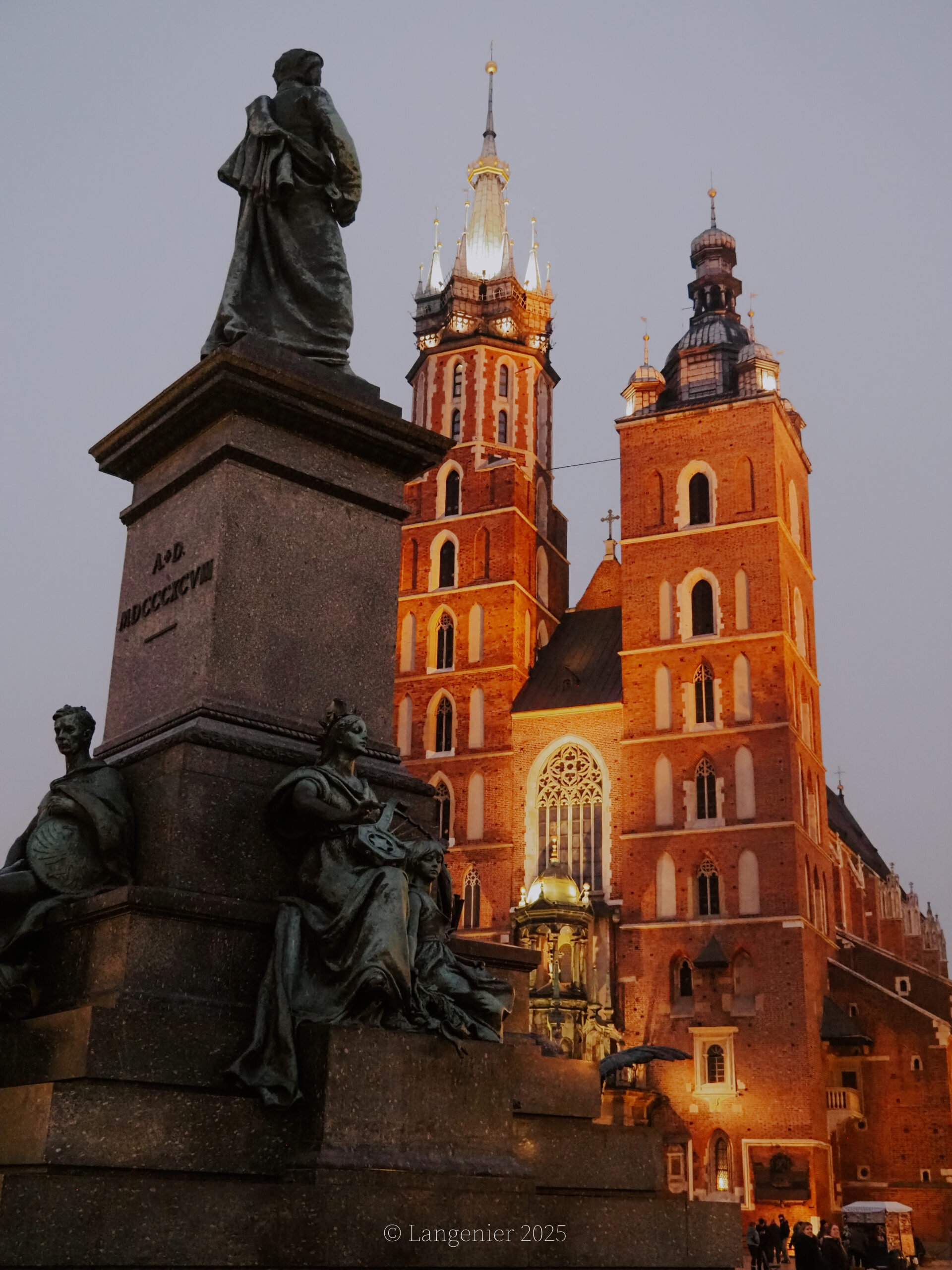
Laid out in 1257, this is the largest medieval square anywhere in Europe, and it shows. The Cloth Hall anchors its center, flanked by St. Adalbert’s Church, the city belfry, and the twin towers of St. Mary’s Basilica. The square has borne witness to centuries of Polish history, and these days it’s filled with festivals, markets, and street performers almost year-round.
It’s center holds the Sukiennice, the Cloth Hall of the city. Once the commercial engine of the city, the Cloth Hall held a Renaissance-era monopoly that made it the only place outsiders could legally trade their wares within Krakow’s walls. Today, its arcaded interior is lined with stalls selling the usual mix of Polish craftsmanship — carved wood, amber jewelry — alongside the inevitable souvenirs, some handmade, others mass-produced halfway across the world. Dig a little, though, and you’ll likely walk away with something worth keeping.
Bazylika Mariacka: The City’s Religious Emblem
St. Mary’s Basilica has presided over the market square in its current Gothic form for some 700 years. A ticket is required to explore the interior fully, but even a glance through the entrance reveals a star-studded vault and richly painted walls — frankly, among the most striking church interiors I’ve come across anywhere. For those willing to go further, the basilica’s true showstopper is the altarpiece by Wit Stwosz: an extraordinary wooden sculpture, widely considered a masterpiece of medieval craftsmanship, depicting scenes from the life of Christ in astonishing detail.
Wawel Castle: A Castle Guarded by a Dragon
The Wawel hill’s foundations date back to the 10th century, and within a hundred years, it had become the seat of Poland’s first kings. But the castle as it appears today is largely a Renaissance creation, shaped by a combination of Polish and Italian architects working together. Its fortunes turned in 1595, when a devastating fire prompted the capital’s move to Warsaw — after which the castle fell into decline, left to looting and a string of foreign occupations. Centuries later, during World War II, it took on a far darker role as the residence of the Nazi governor overseeing occupied Poland. Today, the castle draws hundreds of thousands of visitors a year, its walls layered with the full sweep of Krakow’s history.
Wawel Hill also carries its own slice of folklore: the legend of a fire-breathing dragon said to have once terrorized the city from a cave beneath the castle, devouring residents at will. Every attempt to slay it failed, until a quick-thinking shoemaker stuffed a sheepskin with sulfur and left it for the beast to swallow. The dragon, consumed by thirst, drank its way through the entire Vistula River — which curls around the base of the hill — until it finally burst. These days, the Dragon’s Cave is open to visitors in summer, and the surrounding stalls do a brisk trade in dragon-shaped trinkets and bells, keeping the legend very much alive.
Czartoryski Museum : testimony of the grandeur of Poland
The museum was founded in 1796 by Princess Izabela Czartoryska, with the aim of preserving Polish heritage and chronicling Krakow’s history. Its collections span an impressive range — period furniture, porcelain, tapestries, weaponry, and a notable trove of Roman, Greek, and Egyptian antiquities. But the real draw, the piece that justifies the visit on its own, is Leonardo da Vinci’s Lady with an Ermine, one of the museum’s crown jewels.
2. KAZIMIERZ DISTRICT OF KRAKOW
Krakow’s history is deeply intertwined with its Jewish community, who settled in the region centuries ago and left an indelible mark on the city’s development. That history took a brutal turn during World War II, when the population was confined to ghettos and ultimately deported. Today, traces of this past bears throughout the city — in its architecture, its restaurants, and its museums.
The Synagogue-Museums
Many of Krakow’s synagogues still serve their original religious function, while others have been repurposed as cultural landmarks. The Old Synagogue (Stara Synagoga) now operates as a museum dedicated to Jewish culture in Krakow, while the High Synagogue (Wysoka Synagoga) — badly damaged during the war — now hosts concerts, exhibitions, and gatherings. The Isaac Synagogue conceals a surprisingly ornate Baroque interior, complete with 17th-century Hebrew frescoes, and runs exhibitions and documentaries on the neighborhood’s history. Two synagogues remain active places of worship — the Tempel Synagogue and the Remuh Synagogue — and sit alongside the old Jewish cemetery.
Nowy Square: A Fast Food Temple
At the heart of Plac Nowy, a cluster of stalls specializes one of Poland’s most beloved street foods: the zapiekanka. Picture a halved baguette piled with cheese, mushrooms, meat, and vegetables, grilled until golden, then finished with a generous swirl of sauce. It’s hardly a friend to your cholesterol, but it’s the kind of filling snack that can carry you through an entire afternoon of sightseeing — and trying one is practically a rite of passage in this neighborhood.
Wandering Kazimierz: Street Art and Film Locations
Kazimierz has become an open-air gallery, its old and modern facades alike serving as canvases for street art. At the Galicia Jewish Museum, a striking mural set against a vivid yellow backdrop depicts a menorah — the nine-branched candelabrum lit during Hanukkah. Another piece that stopped me in my tracks sits in Bawół Square: a mural honoring Irena Sandler. This Polish nurse used a special permit to move in and out of the Warsaw Ghetto during the WWII, bringing food, medicine, and aid to those inside. Later, as the head of the underground Council to Aid Jews, she and her network saved 2,500 children by smuggling them out in suitcases, packages, and even coffins. The German army discovered her and arrested her in 1943 before sentencing her to death. But she escaped execution by bribing guards and passed away peacefully at 98 years old.
Not far, Józefa Street carries its own quiet weight, its weathered facades a deliberate contrast to the neighborhood’s gentler corners. It served as a filming location for several scenes in Schindler’s List, including the ghetto liquidation sequence, and today it’s lined with stylish restaurants, bars, and design shops.
3. PODGORZE DISTRICT
Cross the bridge over the Vistula as it winds away from Kazimierz, and you’ll find yourself in Podgórze — the district where, in March 1941, the Nazi regime forced the city’s Jewish population into a sealed ghetto, deliberately isolated from the center.
The Remains of the Ghetto Wall
The Krakow ghetto ranked among the largest in Poland, packing somewhere between 15,000 and 20,000 people into its confines for nearly two years. To seal it off from the rest of the city, every window and door facing the outside world was bricked over, while barbed wire and stone walls — deliberately carved to resemble tombstones — sealed the perimeter. A fragment of that original wall still stands today, restored and preserved as a memorial, tucked between 25 Lwowska Street and 62 Limanowskiego Street.
Bohaterów Square: the Site of Selection for the Death Camps
Bohaterów Square served as the staging ground for roll calls and selections, where Jews were singled out for deportation to the camps. When the ghetto was liquidated in 1943, the square became a site of mass shootings, claiming the elderly, the sick, and children among its victims. One figure stood apart amid the horror: Tadeusz Pankiewicz, who ran the “Under the Eagle” pharmacy overlooking the square. His status as a non-Jew allowed him a measure of freedom he used to smuggle in food and medicine and supply forged documents to those who needed them most.
In 2005, drawing on Pankiewicz’s own written accounts, the city installed a memorial of 68 empty chairs arranged in rows across the square — echoing the lines residents were forced to stand in during roll calls, and evoking the belongings deportees were forced to leave behind before their final journey. Each chair stands for 1,000 of Krakow’s Jewish victims of Nazi persecution.
Deutsche Emailwarenfabrik: The Schindler Factory Museum
Just beside the former ghetto stands Oskar Schindler’s factory, the very site that inspired Steven Spielberg’s Schindler’s List & the best museum Krakow has to offer.
The factory originally produced enamelware under three Jewish owners before being seized and handed to Oskar Schindler, a German businessman, in 1939. Schindler manufactured enamel goods for both civilian and military use, a classification that deemed the factory essential to the war effort — and crucially, allowed his Jewish workforce to keep working there, shielded from deportation. After the ghetto was destroyed in March 1943, Schindler leveraged his connections to set up a sub-camp on site, sheltering 1,000 people under conditions — food, sanitation — far better than anything the main camps offered. The Germans eventually shut the sub-camp down as their defeat drew near, but Schindler wasn’t finished: he opened a munitions factory in Czechoslovakia, ultimately saving the lives of some 1,100 Jewish workers.
Today, the Factory Museum reconstructs daily life in Krakow under Nazi occupation with remarkable attention to detail. Room by room, it recreates specific corners of the city — a hairdresser’s salon, a train station, a forced-labor camp, a busy street scene — and visitors can also walk through Schindler’s actual office and view the list of names he managed to save.
“If winter brings you to Krakow – don’t skip the Christmas season. I’ve written a dedicated guide to the best cozy places to be in the city.